Develop Flawless Pronunciation and Accent.
Pronouncing Swahili words can be as easy as a walk in the park.
Pronouncing Swahili Words: A Walk in the Park
Pronouncing Swahili words can be as easy as a walk in the park. Many of my students have found it easier to pronounce Swahili words than some words in their own languages. So, if you're thinking about skipping this lesson on Swahili pronunciation, don't worry. You can learn as you go and become proficient in pronouncing Swahili words.

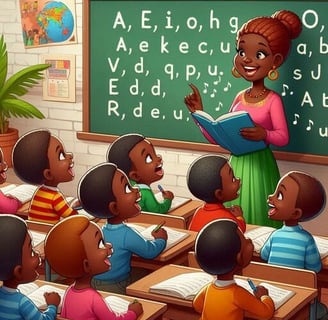
Swahili Alphabet: Familiar Letters
The good news is that the Swahili alphabet includes all the letters of the English alphabet, except for two: Q and X. So, you won't need to learn any new letters. Here are the 24 letters in the Swahili alphabet:
a b c d e f g h
i j k l m n o p
r s t u v w y z


Pronouncing Swahili Words: All You Need to Know
To pronounce Swahili words correctly, follow these steps:
Master the Vowels: Learn the vowel sounds - a, e, i, o, and u. These are syllables (individual parts of the word) on their own.
Consonants with Vowels: Understand how each Swahili consonant sounds when combined with vowels. For example, 'b' with vowels form 'ba, be, bi, bo, and bu.'
Syllables with Multiple Consonants: Learn how syllables with two or more consonants and a vowel are pronounced. For instance, 'k' and 'w' combined with 'a' form 'kwa.'
Word Formation: Put syllables together to form words. When you come across a Swahili word, break it down into syllables and practice pronouncing them.
Unique Sounds: Familiarize yourself with unique sounds that might not exist in English or are pronounced slightly differently in Swahili, like 'ng’a, gha, dha, tha, ra, and ga.' Also, learn the seven Swahili words that are pronounced differently than they are written, including ‘mbu’ (mosquito), ‘mbwa’ (dog), ‘nzi’ (fly), ‘nje’ (outside), ‘nchi’ (country), ‘nge’ (scorpion), and ‘nta’ (earwax).
Perfecting Your Pronunciation: To improve your pronunciation, practice by reading Swahili words, sentences, paragraphs, and stories out loud. Record yourself, and listen to the recordings to identify areas that need improvement. You can find reading material in this book, on my website or online.
If you follow these steps, you'll notice a significant improvement in your pronunciation in no time.


Mastering Swahili Vowels
Flawless Swahili pronunciation hinges on mastering vowels and their sounds. Vowels dictate how you pronounce Swahili words, and they remain consistent across all words. The vowels are:
a - pronounced like 'a' in "back"
e - pronounced like 'e' in "merry"
i - pronounced like 'ee' in "bee"
o - pronounced like 'o' in "of"
u - pronounced like 'oo' in "noon"

Mastering Swahili Consonants
In Swahili, consonants sound similar to English, while vowels are more akin to Spanish. However, a consonant can't be pronounced alone; it must be paired with a vowel. For instance, to pronounce 'g' in Swahili, add a vowel like 'a' after it, creating 'ga' pronounced as /ga/ in ‘gallon.’ Each sound produced when pronouncing a Swahili word is called a syllable.
Mastering Swahili Syllables
Syllables are the individual sounds or parts of the word in Swahili. They combine to create meaningful words. A syllable can consist of a single vowel, like 'a,' a consonant and a vowel, like 'za,' or multiple consonants with a vowel, like 'kwa' and 'ngwa.'
For example:
babu /bahboo/ - has two syllables: 'ba' and 'bu.'
kulala /koolalah/ - has three syllables: 'ku,' 'la,' and 'la.'
ua /ooah/ - has two syllables: 'u' and 'a.'
kwamba /kwamba/ - has two syllables: 'kwa' and 'mba.'
chungwa /choongwah/ - has two syllables: 'chu' and 'ngwa.'
anaandika /anaandeekah/ - has five syllables: 'a,' 'na,' 'a,' 'ndi,' and 'ka.'


A Swahili syllable always includes a vowel. While a vowel can stand alone as a syllable, a consonant cannot be a syllable without a vowel. The exception is 'm,' which can be pronounced separately when followed by another consonant, as in 'mtu' (person). When 'm' is followed by a vowel, it is pronounced together with the vowel as one syllable, like 'ma' in 'mama' (mother). However, 'm' can still require the help of 'w' or 'u' in some cases, such as in the verb 'ambia' (tell), when ‘M’ means ‘Him/Her,’ ‘w’ has to be added between the ‘m’ and ‘ambia’ forming 'Mwambia' (tell him/her) for clearer pronunciation.
How to Pronounce Swahili Words
To correctly pronounce a Swahili word, you need to learn and master the pronunciation of the syllables (or individual parts) that make up the word. Pay attention to the vowels used in these syllables and worry less about the consonants before them, as they sound more like English consonants. For instance, the consonants 'b,' 'g,' and 'j' are pronounced differently based on the following vowel:
B is pronounced as /bah/ in 'ba,' /beh/ in 'be,' /bee/ in 'bi,' /boh/ in 'bo,' and /boo/ in 'bu.'
G is pronounced as /gah/ in 'ga,' /geh/ in 'ge,' /gea/ in 'gi,' /goh/ in 'go,' and /goo/ in 'gu.'
J is pronounced as /jah/ in 'ja,' /jeh/ in 'je,' /jee/ in 'ji,' /joe/ in 'jo,' and /joo/ in 'ju.


Exceptions to Note
While most Swahili syllables or sounds resemble English sounds, there are a few exceptions:
C is always paired with 'h,' forming 'ch,' similar to the 'ch' in the English word 'church.' For example, 'cha,' 'che,' 'chi,' 'cho,' 'chu.'
G is always pronounced like the English 'g' in 'go,' not like 'j' as in 'genetics.' For example, 'ga,' 'ge,' 'gi,' 'go,' 'gu.'
R is always rolled in Swahili, unlike the English 'R.' Some Swahili speakers may mistakenly interchange 'R' with 'L,' as in 'barabara' (road), which might be pronounced as 'balabala.' However, this doesn't affect the meaning.


Stress in Swahili Words
In Swahili, stress falls on the second-to-last syllable in a word. This means you emphasize this syllable more as you pronounce the word. For instance:
Kitabu (ki-ta-bu) = The stress falls on 'ta.'
Ninamsaidia (ni-na-m-sa-i-di-a) = The stress falls on 'di.'
Baba (ba-ba) = The stress falls on the first 'ba.'


Consonant Clustering in Syllables
A typical Swahili syllable or sound consists of one consonant paired with a vowel. However, some syllables have two or more combined consonants, pronounced together as a single sound. This phenomenon is known as consonant clustering. The good news is that English also has such syllables, and Swahili consonant clusters often follow similar pronunciation patterns. You'll likely find them quite manageable.
For example:
'Andikwa' (be written): The syllable 'kwa' has a consonant cluster ‘kw’, and you pronounce it together, like the ‘qua’ in the English word 'squats,' while the syllable 'ndi' has a consonant cluster ‘nd’, and you pronounce it together, like the ‘nde’ in the English word 'dandelions.'
Other examples of consonant clusters can be founds in words like ‘chumba’ (room), ‘chungwa’ (orange), ‘kunywa’ (to drink), ‘kichwa’ (head), ‘umbwa’ (be created), and many more.



Unusual Sounds (Syllables) in Swahili
Swahili contains some syllables that might sound a bit unusual to English speakers. However, they are not difficult to pronounce, and many have English equivalents or close approximations. Additionally, some of these sounds exist in English but are pronounced slightly differently in Swahili. They include:
dha, dhe, dhi, dho, dhu
These resemble the 'tha' in 'that,' 'the' in 'then,' 'thy' in 'worthy,' 'tho' in 'though,' and 'thu' in 'thooo' respectively. You can find them in words like 'dhambi' (sins), 'dhehebu' (denomination), 'udhi' (annoy), 'dhoofu' (become weak), and 'dhulumu' (unjustly take what someone else deserves).
tha, the, thi, tho, thu
These are similar to the 'thu' in 'thumb,' 'the' in 'catheter,' 'thy' in 'wealthy,' 'tho' in 'thorough,' and 'thu' in 'enthusiasm' respectively. You can encounter them in words like 'thamani' (value), 'thelathini' (thirty), 'urithi' (inheritance), 'thori' (impotent), 'thubutu' (dare), and more.
gha, ghe, ghi, gho, ghu
There is no exact English equivalent for these sounds. To pronounce them correctly, imagine softening your throat as if you have water in your mouth and you're trying to say 'go' or 'ghost.' It's like when you're rinsing your mouth after brushing your teeth and someone asks you an important question like "unakula ugali?" (Are you eating ugali?). Your pronunciation of 'ga' in 'ugali' will be very soft and somewhat like 'gha.' The 'gh' sound can be challenging, even for native Swahili speakers. In Mainland Tanzania, you'll often hear people simplify these syllables as 'ga ge gi go gu,' omitting the 'h.' In Zanzibar, some might even drop the 'g' and pronounce them as 'ha he hi ho hu.' If you find it difficult to pronounce them softly, as if your mouth is full of water, don't worry. Pronouncing them as 'ga ge gi go gu' is correct and sounds natural. They can be encountered in words like ‘lugha’ (language), ‘ghali’ (expensive), ‘ghiliba’ (deception), ‘ghorofa’ (storey), ‘shughuli’ (activity), and more.
ng'a, ng'e, ng'i, ng'o, ng'u:
There is no direct English equivalent for this set of sounds either. They are somewhat similar to the 'ng' in English words like 'sing,' 'bring,' and 'hang.' Picture yourself saying "hang out," "sing in," or "bring on." The sound you make after the 'ha,' 'si,' or 'bri' is exactly how you pronounce the Swahili "ng'a, ng'e, ng'i, ng'o, ng'u" sounds. These sounds can be found in words like 'ng'aa' (shine), 'meng'enya' (digest), 'ning'iniza' (hang), 'ng'ombe' (cow), and 'nung'unika' (complain/grumble).








Words with Irregular Pronunciation
Some Swahili words, though single-syllable, are pronounced as two-syllable or two-part words due to the emphasis on the initial 'm' or 'n' sound. These sounds are stretched out and pronounced with greater emphasis. They include:
Mbwa - dog is pronounced as /Mmmbwa/.
Mbu - mosquito is pronounced as /Mmmbu/.
Nta - earwax is pronounced as /Nnnta/.
Nge - scorpion is pronounced as /Nnnge/.
Nje - out or outside is pronounced as /Nnnje/.
Nchi - country is pronounced as /Nnnchi/.
Nzi - fly is pronounced as /Nnnzi/.




While there may be other words with irregular pronunciation, these seven are commonly used in Swahili.
By following these guidelines, you can confidently learn to pronounce Swahili words clearly and naturally.