Discussing Abilities or Capabilities
At some point, you'll likely need to express what you or someone else is capable of doing essentially, discussing abilities or capabilities.
5/21/20242 min read

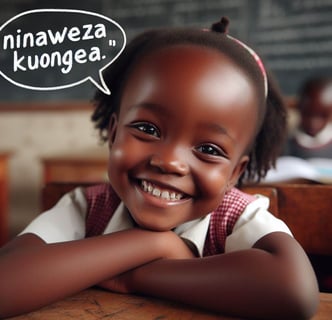
DISCUSSING ABILITIES OR CAPABILITIES
At some point, you'll likely need to express what you or someone else is capable of doing – essentially, discussing abilities or capabilities. In such situations, the verb 'weza' becomes essential.
'Weza,' the base form of the infinitive 'kuweza,' can be translated literally as 'be able [to...].' However, in a semantic context, 'weza' can also represent 'can' in English, while 'kuweza' means '[to] can.'
Weza = be able or can
Kuweza = to be able or to can
While 'can' always functions as a helping (auxiliary) verb in English, meaning it's neither preceded nor followed by the conjunction 'to' in sentences, the Swahili verb 'weza' behaves differently. It's used as a main verb, transforming into 'kuweza' (to can) and 'weza kufanya kitu' (can to do something). Therefore, initially translating it as 'be able [to...]' can provide a clearer understanding when learning it for the first time, making 'kuweza' signify 'to be able' and 'kuweza kufanya kitu' signify 'to be able to do something.'
When using the verb 'weza' in sentences, remember to treat it like other verbs such as 'penda' (like), ‘lala’ (sleep), and ‘taka’ (want). When followed by another verb, the subsequent verb should begin with 'ku' (to) instead of its base form or stem. For example:
● Ninaweza cheza mpira (I can play soccer) is incorrect.
● Ninaweza kucheza mpira (I can [to] play soccer) is correct.
While some native speakers, especially those from Kenya, may omit 'ku' from the verb following 'weza,' as is done in English when 'can' is followed by another verb, this is generally reserved for creative works like poems and songs in Swahili. In everyday conversations, it's considered incorrect. In such cases, you should always say 'weza kufanya,' not 'weza fanya'.
What can you do?
To discuss abilities or what either you or someone else can do, simply conjugate the verb 'weza,' making it grammatically agree with the person possessing the ability or their pronoun. Then, state the activity (verb) they can do, always beginning with 'ku.' The examples below illustrate this:
Ninaweza kupika ugali = I can cook ugali (I am able to cook ugali).
Chatenga anaweza kuongea Kiingereza = Chatenga can speak English.
Mama na baba wanaweza kusoma vitabu = Mom and dad are able to read books.
Wewe na jirani yako mnaweza kuishi vizuri = You and your neighbor can live well.
Mimi na Xavery tunaweza kuongea Kiswahili = Xavery and I can speak Swahili.
Unaweza kuimba vizuri = You can sing well.
Now, go ahead and confidently share your abilities: unaweza kufanya nini? (What can you do?):
Unaweza kuimba? (sing) =
Unaweza kujenga nyumba? (build) =
Unaweza kuendesha gari? (drive, car) =
Unaweza kupika ugali? ugali (East African stapple) =
Unaweza kuongea Kichina? =
Unaweza kufanya nini?